San Francisco Multi-Ethnic “National Day of Mourning” Rally Calls for an End to Persecution and Defense of Freedom and Human Rights
Translate from 舊金山多族裔「國殤日」集會 籲停止迫害、捍衛自由人權
By Lin Ruoshui, The Epoch Times | San Francisco
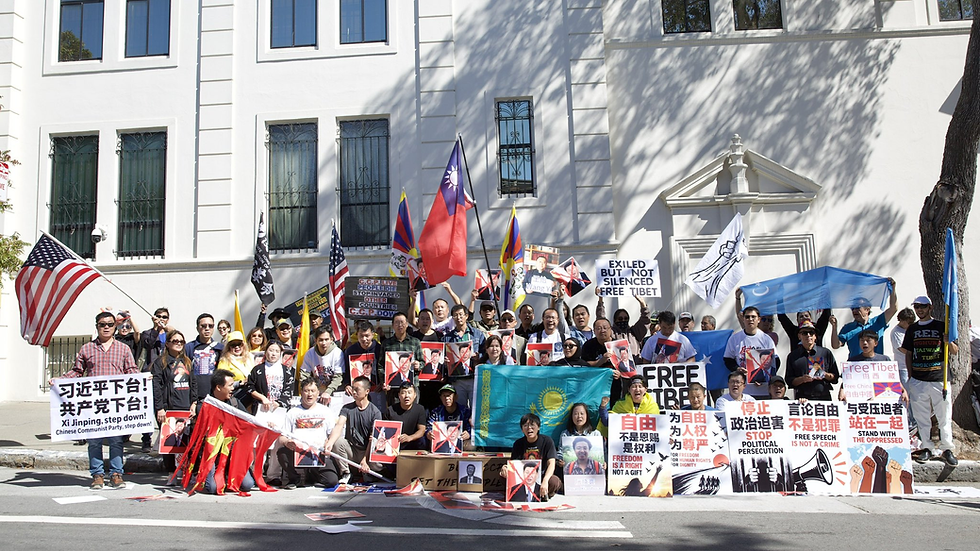
At noon on October 1, people from a range of ethnic and community backgrounds—including China, Hong Kong, Tibet, East Turkestan, Southern Mongolia, Vietnam, and the Philippines—gathered outside the Chinese Consulate General in San Francisco for a joint protest marking a “National Day of Mourning.” Under the theme “Speaking Out for Freedom, Human Rights, and Dignity,” participants called for an end to political persecution and transnational repression, and for the protection of human rights, religious and cultural freedom, and regional peace.
Participating organizations included the San Francisco branch of the China Democracy Party, the Chinese Democracy Education Foundation, the Northern California Hong Kong Club, the Hong Kong American Association, the San Francisco Tibet Support Group, and the Alliance Against China’s Occupation and Repression in Asia.
Participants carried flags and signs in Chinese and English bearing messages such as “Free Speech Is Not a Crime,” “Human Rights Must Not Be Trampled,” “Stop Transnational Repression,” “Stop Political Persecution,” and “For Freedom, Human Rights, and Dignity.”
One of the event’s hosts, Zhou Yunlong, said that while October 1 is celebrated by the Chinese Communist Party (CCP) as “National Day,” for many who have experienced political persecution under CCP rule, the date is instead a “National Day of Mourning” commemorating suffering.
He said the rally’s main demands included restoring civil liberties, democracy, and human rights in mainland China and Hong Kong; ending religious and cultural repression targeting Uyghurs, Tibetans, Southern Mongolians, and other groups; ending expansionist activities in the South China Sea; and respecting the territorial and maritime rights of other countries.

Three Generations of Suffering — Zhao Ming: “Today, I Will No Longer Remain Silent”
Zhao Ming, a democracy activist from Anhui Province, China, recounted the suffering endured by three generations of his family under CCP rule.
Zhao recalled that around 1960, his grandfather, grandmother, and aunt died of starvation during the Great Famine. His father, who was only eight years old at the time, survived by wandering from place to place and begging for food.
Decades later, Zhao said, tragedy struck his own family. In 2012, his wife became pregnant again. When she was more than four months pregnant, she faced pressure including the threat of losing her job, the possibility that their child would be denied household registration, and a massive fine. She was forced to undergo an induced abortion and subsequently suffered severe hemorrhaging.
“I hate my own helplessness. I couldn’t protect my own flesh and blood!” Zhao said, his voice choking with emotion.
Zhao said that in 2015, after signing a petition in support of journalist Gao Yu, he was taken away by state security officers, beaten at a police station, and forced to write a statement promising compliance. In 2021, his family home was forcibly demolished, and both he and his elderly father were dragged outside and pinned to the ground. After repeated attempts to seek redress failed, he eventually left China.
He also said that even after he arrived in the United States, Chinese police continued to threaten his wife, who remained in China, and demanded that he stop speaking out overseas.
“Today, I am no longer afraid. I will no longer remain silent!” Zhao said.
He argued that without democracy, human rights, and meaningful constraints on government power, ordinary people’s property, freedom, and dignity cannot be adequately protected.
Tibetans Remember Kelsang Namtso and Raise Concerns About Ethnic Policies and Cultural Preservation
Several Tibetans and supporters of Tibet spoke at the rally about religious freedom, language, education, and the preservation of Tibetan culture.

Giovanni Vassallo, president of Bay Area Friends of Tibet, said that for Tibetans, October 1 is not a day to celebrate. He specifically commemorated Kelsang Namtso, a 17-year-old Tibetan Buddhist nun who was killed on September 30, 2006.
At the time, Kelsang Namtso was traveling with a group of approximately 70 Tibetans attempting to cross the Nangpa La Pass on the Tibet-Nepal border into Nepal when Chinese border guards opened fire on the group, killing her. Foreign mountaineers nearby witnessed and filmed the incident. A subsequent U.S. State Department report noted that video footage showed the Tibetans were unarmed and were fired upon from behind.
Vassallo also criticized the Law on Promoting Ethnic Unity and Progress, which took effect on July 1 this year, arguing that the policy has intensified Tibetan concerns about the erosion of their language, religion, and ethnic culture.
He also noted that information inside Tibet is tightly controlled, making it difficult for the outside world to obtain independent information following major natural disasters and human rights incidents.

Gangchen Wangmo, a board member of the San Francisco Regional Tibetan Youth Congress (SFRTYC), focused on the Panchen Lama and the issue of Tibetan children in boarding schools.
She spoke about Gedhun Choekyi Nyima. In May 1995, the Dalai Lama recognized the then-six-year-old Gedhun Choekyi Nyima as the 11th Panchen Lama. Several days later, he and his family were taken away by Chinese authorities. The U.S. Commission on International Religious Freedom continues to list his status as “Unknown.” The Chinese government, meanwhile, has previously stated that he received an education, has a job, and does not wish to be disturbed by outsiders.
Gangchen Wangmo also criticized the boarding-school system for Tibetan children, arguing that separating children from their families and native-language environment for extended periods threatens the continued transmission of the Tibetan language and traditional culture.
Speaking about Tibetans who have carried out self-immolation protests against Chinese government policies in Tibet in recent years, she said that commemorating them is “not about glorifying death,” but about hoping for a future in which no one feels driven by despair to make such a choice.


Tenzin Pema, an executive committee member of the San Francisco Regional Tibetan Youth Congress, addressed the rally from a broader multi-ethnic perspective. She read a joint statement covering issues involving Tibet, Uyghurs/East Turkestan, Southern Mongolia, Hong Kong, Taiwan, Vietnam, and the Philippines. The statement called for an end to cultural and ethnic repression, the restoration of freedoms in Hong Kong, the preservation of peace in Taiwan, and an end to transnational repression.
Ginger Duan Speaking for Those Inside China Who Cannot Speak Freely
Duan Jingji, president of the Chinese Youth Stand with Tibet, spoke in particular about the situation of Zhang Yadi, also known as Tara, a young member of the organization.
Duan said that Zhang had previously studied in France and was arrested after returning to China in the summer of 2025 to visit her parents. She is currently facing accusations of “inciting separatism.”
Duan said that those living overseas who are able to speak publicly should not only advocate for their own communities, but also speak for those who remain in China and are unable to express themselves freely.

“I hope culture and language will not become barriers between us,” she said, calling on people from different communities to overcome their differences and stand “shoulder to shoulder, hand in hand.”
Duan then recited a poem in Chinese commemorating political prisoners and victims of persecution, concluding her remarks with the words: “Free China.”
Yang Chaoquan Reviews the CCP’s Political Campaigns

Democracy activist Yang Chaoquan discussed the meaning of “National Day of Mourning” through the history of the 77 years since the CCP established the People’s Republic of China.
He reviewed political campaigns and historical events including land reform, the Campaign to Suppress Counterrevolutionaries, the Anti-Rightist Campaign, the Great Leap Forward and Great Famine, the Cultural Revolution, and the 1989 Tiananmen Square crackdown, saying that successive political campaigns resulted in enormous loss of life and shattered countless families.
“Among them were teachers, students, fathers, and mothers. They could have been people from our parents’ generation,” he said.
Speaking about the June 4, 1989 crackdown, Yang said that students and citizens at the time raised demands including fighting corruption and calling for dialogue with the government, but were ultimately met with armed suppression. More than three decades later, he noted, the Chinese government has still not released a complete death toll.
He said that remembering this history is precisely why many participants refer to October 1 as a “National Day of Mourning.”
Chen Suoming: “China Belongs to the Chinese People”

Democracy activist Chen Suoming, also known as Albert, focused his remarks on China’s political system and civil rights.
“Don’t believe something simply because the Chinese Communist Party says it,” he said. “Look at what it actually does.”
Chen said that people in China should have the right to choose their government through democratic elections, that elections should be open and fair, and that governments should be subject to oversight by the people, the law, and the media rather than allowing one political party to permanently monopolize power.
“We want freedom. We want democracy. We want basic human rights.”
He concluded: “China belongs to the Chinese people, not to any political party.”
Vietnamese Participants Raise Concerns About the South China Sea
Representatives of the Vietnamese community brought attention to the South China Sea and the CCP’s foreign policy.

Jack Duong, founder of the Alliance Against China’s Occupation and Repression in Asia and one of the event’s hosts, said the multi-ethnic gathering had three purposes: to draw attention to human rights issues under CCP rule, to defend national sovereignty and international law, and to demonstrate solidarity among different communities.
He criticized the CCP’s militarization of the South China Sea and its maritime claims, arguing that its actions affect the rights and interests of neighboring countries, including Vietnam and the Philippines.

Vietnamese community member Jennie Ha Phan likewise criticized the CCP regime’s expansion in the South China Sea and called on the international community to pay greater attention to the pressure it places on neighboring countries.
The 2016 South China Sea arbitration addressed the relationship between China’s claims to historic rights within the “nine-dash line” and the United Nations Convention on the Law of the Sea. The arbitral tribunal ruled that China’s claims to historic rights within the waters encompassed by the “nine-dash line” had no legal effect to the extent that they exceeded the maritime entitlements provided for under the Convention.
Jennie Ha Phan said that people must unite in opposition to the CCP regime, warning that otherwise “they will ultimately destroy us.” She said the world must recognize what she described as the CCP’s ambition to control humanity, and accused the regime of committing genocide and engaging in unlawful expansion.
“The world must wake up,” she said, urging people to spread the message widely and declaring that “the CCP regime must disappear completely from this world.”
Different Communities, Shared Demands
Flags representing Tibet, East Turkestan, Southern Mongolia, Vietnam, and other communities could be seen throughout the rally.
Although participants came from different ethnic, cultural, and political backgrounds, speakers repeatedly emphasized a number of shared concerns: ending political persecution and transnational repression, protecting freedom of speech, religion, and culture, and calling on the international community to continue paying attention to China’s human rights situation and the CCP’s foreign policies.
Chants in different languages and flags from different communities filled the area outside the Chinese Consulate.
At the conclusion of the event, participants once again chanted slogans calling for freedom, human rights, and democracy, bringing the day’s rally to a close.


Comments